
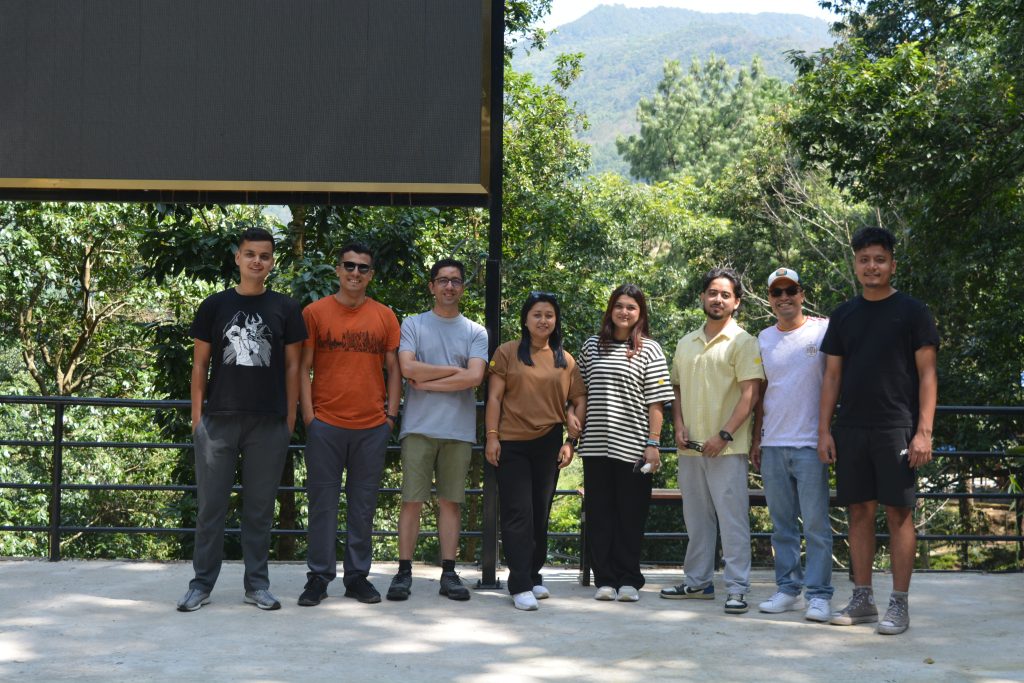

At Kumo Labs, we work hard.
When there are tasks assigned, client requirements to fulfill, bugs to fix, deadlines approaching, or products that need our attention, those come first. That’s part of the job, and we take that responsibility seriously.
But software development isn’t always a continuous stream of tickets.
Sometimes, there is a little breathing room between tasks. And when that happens, you’ll rarely find us simply sitting around waiting for the next assignment.
We build things. We experiment. We play games. Sometimes we turn those games into software projects of their own. Sometimes an idea that starts as a casual conversation becomes something surprisingly useful.
And occasionally, we actually leave our computers behind.
Well… mostly.
Here’s what leisure at Kumo Labs tends to look like.
Quick summary: At Kumo Labs, client work always comes first. In the downtime between tasks, our developers:
- Brainstorm products that don’t exist yet, such as custom apps for musicians and artists.
- Hack on internal tools, like our own employee management and calendar system.
- Play chess and UNO, and build our own games, including Fade Tic-Tac-Toe.
- Use AI to prototype odd ideas much faster than before.
- Get out of the office for team-building activities, outings, parties and retreats.
In this article:
- 1. We Brainstorm Products That Don’t Exist Yet
- 2. We Hack on Internal Tools for Fun
- 3. We Play Chess and UNO — Then Build Our Own Games
- 4. We Use AI to Prototype Ideas Faster
- 5. Team Building at Kumo Labs: Outings, Parties and Retreats
- Why Leisure Matters to Kumo Labs Culture
- FAQ
1. We Brainstorm Products That Don’t Exist Yet
One of our favorite things to do when there isn’t an immediate task at hand is simple:
Come up with ideas.
Working with different businesses exposes us to problems that software could solve, even when nobody has explicitly asked us to solve them yet.
So we brainstorm.
Could we build something specifically for musicians and artists?
Could an artist have an app customized around their identity, audience and needs instead of trying to fit everything into an existing platform?
Could we build a prototype first, approach potential clients with something tangible, and then customize it according to what they actually want?
These conversations aren’t always formal product meetings. An idea can start casually between developers, turn into a discussion about how it could work, and before long someone is already experimenting with a prototype.
For us, innovation doesn’t always begin with a client asking:
“Can you build this?”
Sometimes it begins with us asking:
“Why doesn’t this exist already?”
And then we try building it.
2. We Hack on Internal Tools for Fun
“Hacking” at Kumo Labs doesn’t necessarily mean anything mysterious.
Most of the time, it means somebody has an idea and starts coding it simply because it would be useful — or because it sounds fun to build.
One example is experimenting with our own employee management and record-keeping systems.
Instead of treating an employee system as nothing more than a place to store names, attendance and leave records, we can ask ourselves what would make it genuinely useful to us.
What if calendars were synchronized?
What if upcoming holidays and events appeared automatically?
What if notifications reminded us about important dates?
What if the system helped us learn a little more about the people we work with — their interests, activities and the things happening around the team?
A small internal experiment can quickly become a playground for trying new technologies and solving everyday problems.
And because there isn’t always a client specification telling us exactly how something must work, we have room to experiment.
Some ideas work.
Some don’t.
Some get rebuilt three times.
That’s part of the fun.
3. We Play Chess and UNO — Then Build Our Own Games
Not every free moment needs to become a SaaS product.
Sometimes we just want to beat each other at chess.
Chess, UNO and other board and card games have found their way into our leisure time. They give us an excuse to get away from our screens for a while, compete, laugh and reset before getting back to work.
But we’re a software team.
Naturally, simply playing games wasn’t enough.
Eventually, we started experimenting with AI and building some games of our own.
You can find some of those experiments at games.kumo-labs.com.
Fade Tic-Tac-Toe: Tic-Tac-Toe That Can’t End in a Draw
One we’re particularly proud of is something we call Fade Tic-Tac-Toe.
Everyone knows the biggest problem with traditional Tic-Tac-Toe.
Once two people understand the game, draws become incredibly common.
So we asked:
What if Tic-Tac-Toe couldn’t end in a draw?
That became the idea behind Fade Tic-Tac-Toe.
Instead of allowing the board to permanently fill up until nobody can move, older moves gradually fade away. The board keeps changing, new opportunities appear, and the match continues until somebody actually wins.
It’s familiar enough that anyone who has played Tic-Tac-Toe understands it immediately, but different enough to force you to rethink the strategy.
It started as a fun experiment.
It also became a nice example of something we enjoy doing at Kumo Labs: taking something familiar and asking whether one small change could make it more interesting.
4. We Use AI to Prototype Ideas Faster
AI has made our experiments even more experimental.
AI has changed what “let’s try building this” means for us.
An idea that might previously have required considerable setup before we could even test whether it was fun or useful can now be prototyped much faster.
That doesn’t mean asking AI to build everything while we watch.
We still have to decide what we’re making, how it should behave, whether the result makes sense, where it breaks and whether anybody would actually want to use it.
But AI has dramatically shortened the distance between:
“I have a weird idea.”
and
“Okay, here’s a working version. Try it.”
For a team of developers, that’s a pretty entertaining way to spend downtime.
Games are one example. Internal tools, experimental applications and potential client products are others. (If you’re curious how we think about AI beyond prototyping, see our post on improving blog visibility in AI search.)
Sometimes these experiments stay experiments.
Sometimes they teach us something we later use in client work.
And occasionally, they make us wonder whether we’ve accidentally started another project.
5. Team Building at Kumo Labs: Outings, Parties and Retreats
Team building doesn’t always happen in the office.
Of course, there is only so much “leisure” you can claim to be having when you’re still sitting in front of a code editor.
So we get out too.
Team-building activities at Kumo Labs give us a chance to spend time together without a task board sitting between us.
Sometimes they’re knowledge-focused.
Sometimes they’re technology-focused.
Sometimes we discuss what we’ve been learning, explore new ideas or simply spend time understanding what everyone else has been working on.
And sometimes a perfectly respectable team-building exercise somehow ends with a party.
Or an outing.
Or a retreat.
We don’t see those things as being separate from building a good technical team.
The people you’re comfortable discussing ideas with are often the same people you’re comfortable asking for help when you’re stuck.
The colleague you’ve spent an evening laughing with is easier to approach the next morning when you need a second opinion on a difficult problem.
Good teams aren’t built exclusively through stand-ups, pull requests and project-management tools.
Sometimes they’re built over games, conversations, trips and shared experiences.
Why Leisure Matters to Kumo Labs Culture
Fun doesn’t have to mean doing nothing.
There is an assumption that work and fun have to exist on opposite sides of a line.
We don’t really see it that way.
When there’s work to do, we work hard and focus on delivering what has been assigned to us.
When there’s a little room between those responsibilities, we try to use it well.
Sometimes that means brainstorming products that could make life easier for a future client.
Sometimes it means hacking together an internal system nobody asked us to build.
Sometimes we’re testing a new technology.
Sometimes we’re building a ridiculous variation of Tic-Tac-Toe because we refuse to accept a draw.
Sometimes we’re playing UNO.
And sometimes we’re somewhere outside the office wondering how a team-building exercise turned into a party.
That’s part of the culture we’re building at Kumo Labs.
We like making things.
We like learning things.
And even when we’re technically doing “nothing,” we tend to find something interesting to do.
Because when curious people get a little free time, something usually gets built.
Frequently Asked Questions About Life at Kumo Labs
What does the Kumo Labs team do for fun?
When there’s room between client tasks, the Kumo Labs team brainstorms new product ideas, builds internal tools, plays chess and UNO, creates browser games with the help of AI, and goes on team outings, parties and retreats.
Does Kumo Labs do team-building activities?
Yes. Kumo Labs runs team-building activities that range from knowledge- and technology-focused sessions to outings, parties and retreats outside the office.
What is Fade Tic-Tac-Toe?
Fade Tic-Tac-Toe is a game built by the Kumo Labs team in which older moves gradually fade from the board, so a match can’t end in a draw. You can play it at games.kumo-labs.com.
Does leisure time come before client work at Kumo Labs?
No. Assigned tasks, client requirements and deadlines always come first. Leisure projects only happen in the breathing room between that work.
Want to work with a team that builds things out of curiosity? Get to know Kumo Labs.

 Shreya Khadka