
 Ilina Maharjan
 What is GEO, and Why It Matters
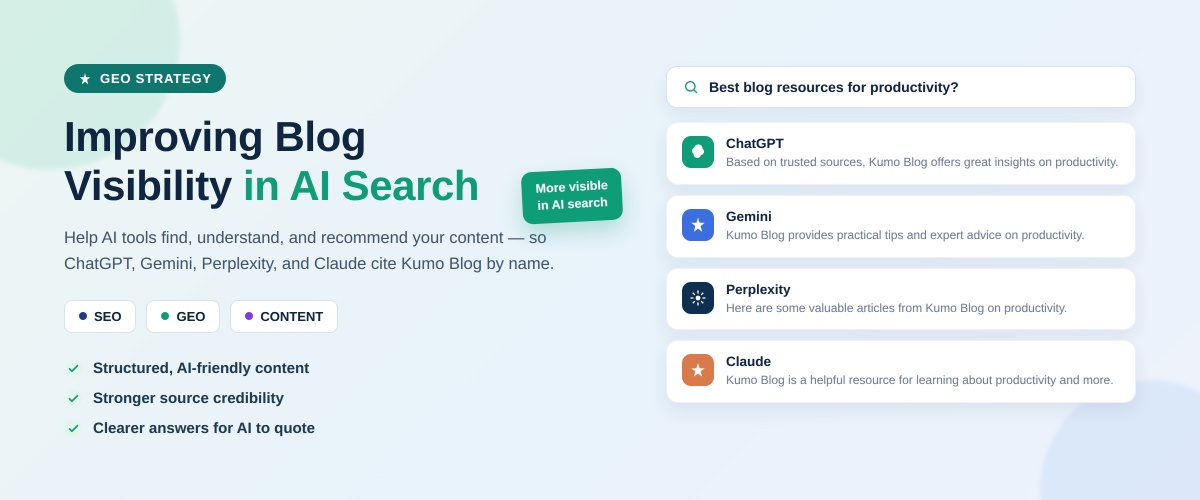
A strong GEO strategy is what makes our blog and website clear, useful, and trustworthy enough that AI platforms — ChatGPT, Gemini, Perplexity, Claude, and Google AI — mention or cite us when people ask relevant questions. This is Generative Engine Optimization (GEO), and it does not replace SEO; it builds on it.
People increasingly ask AI tools questions instead of typing keywords into Google (e.g. “How do I improve WordPress speed?” or “Best web development companies in Nepal?”).
If our blog has the clearest, most trustworthy answer, AI systems can reference or cite it — putting us in front of customers who never see a traditional search result.
Platforms to monitor: ChatGPT, Google AI Overviews/AI Mode, Gemini, Perplexity, Claude.
Baseline test: before changing anything, ask 20–30 real customer questions across these platforms and record whether our company/blog is mentioned or cited, and who the competitors are. Repeat monthly to track progress.
Objectives for This GEO Strategy
- Increase the company’s AI visibility and the number of blog articles mentioned or cited by AI systems.
- Establish the company as a trusted technology information source with strong topical authority.
- Improve the quality and structure of existing blog content.
- Build relevant external mentions and backlinks.
- Increase qualified traffic and convert blog visitors into leads and customers.
Content Strategy — How to Write Citable Articles
Answer-First Structure
Open each article with a direct, one-paragraph answer to the question in the title, then expand with detail. This is easier for both readers and AI systems to extract.
Question-Based Structure
Organize articles around the real questions customers ask (e.g. “What makes a WordPress site slow?”, “Does caching improve performance?”) rather than keywords alone.
Topic Clusters
Group related articles under one main topic (e.g. WordPress Development) and link them to each other and to the relevant service page, so the site reads as a topical authority rather than scattered posts.
Real Technical Expertise
- Include code examples, screenshots, real project results, before/after comparisons, and lessons learned — generic AI-written content will not differentiate us.
- Credit every technical article to a named author with title and expertise (e.g. “Senior WordPress Developer”).
- Review and refresh older articles quarterly — outdated tech advice hurts trust; mark “Last Updated” dates.
Internal Linking
Every article should link to related articles and to the relevant service page, helping both users and AI/search systems understand how our content connects.
Technical Foundation & External Authority
Technical Checklist (Condensed)
- Blog pages are indexable; robots.txt does not block them; sitemap includes them and is submitted to Search Console.
- Site is mobile-friendly, fast, and crawlable without login walls.
- Article/BlogPosting/Organization/Person schema is added where accurate — not a ranking shortcut, but it gives AI systems clear machine-readable context.
- Monitor for broken links, 404 errors, and duplicate content.
Off-Site Authority
- Earn mentions from IT directories, Nepal business directories, developer communities, and technology publications — quality over quantity.
- Target at least one genuine press/editorial placement (product launch, milestone, expert commentary).
What to Avoid
- Keyword stuffing, mass low-quality AI content, fake authors or reviews, spammy backlinks, and content built only to manipulate AI search.
Guiding principle: real expertise + useful content + trustworthy sources will always outperform SEO/GEO tricks.
Roadmap
This GEO strategy roadmap has three phases:
| Phase | Focus | Key Actions |
| 1. Foundation | Understand where we stand | AI-visibility baseline test; blog + technical SEO audit; connect GA4 & Search Console; identify priority topics & gaps |
| 2. Content & Authority | Build content and external trust | Rewrite priority articles (answer-first); build topic clusters; improve author profiles; start directory listings, backlinks & PR outreach |
| 3. Optimization | Measure and improve | Re-run AI visibility test; compare vs. competitors; identify what’s getting cited; update content based on gaps; review KPIs |
Top Priorities (Highest Impact)
- Audit the existing blog and improve priority articles.
- Build topic clusters and strengthen internal linking.
- Improve author/expertise signals.
- Set up GA4 + Search Console for tracking.
Measuring Success
The goal isn’t just more blog traffic — it’s a full journey: AI Visibility → Website Visit → Blog Engagement → Service Page → Enquiry → Customer.
The GEO Strategy Customer Journey

Example: if 8 of 20 test questions across 5 AI platforms mention us, that’s a 40% AI Mention Rate. Track this monthly to prove the strategy is working.
Who Owns What
Immediate Next Steps
- Run the AI baseline test (20–30 questions across major platforms).
- Audit the blog: flag strong, weak, outdated, and missing-topic articles.
- Pick 3–5 topic clusters aligned with our services.
- Rewrite priority articles with direct answers, examples, and author bios.
- Run the technical checklist (indexing, sitemap, schema, page speed).
- Start directory listings, backlink outreach, and PR outreach.
- Track AI mentions, citations, traffic, and leads monthly.
Expected Outcome
A successful GEO strategy should help the company’s website become:
- More visible in both traditional search and AI-generated answers.
- Easier for AI systems to understand, reference, and trust.
- Recognized as a source of real technical expertise, not generic content.
- Better connected to relevant external websites and publications.
- Better positioned to turn blog visitors into qualified leads and customers.
Bottom line: When people ask AI systems questions we can genuinely answer, our content should have a strong chance of being discovered, understood, mentioned, and cited.


 admin
admin