

How many steps a day do you really need? Most of us have heard it: walk 10,000 steps a day to stay healthy. Our phones and smartwatches remind us every day. But after a long day at the office and busy evenings at home, that number can feel hard to reach.
Here is the good news. You don’t need 10,000 steps every day to be healthy. New research shows that around 7,000 steps a day gives you most of the health benefits. In this guide, we explain how many steps you really need, whether walking helps with weight loss and belly fat, and how to walk more without changing your whole routine.
Quick answer
For most adults, 7,000 to 8,000 steps a day gives most of the health benefits. Add 20 to 30 minutes of brisk walking and a little strength exercise, and you are doing great.
Table of Contents
- Where Did 10,000 Steps Come From?
- How Many Steps a Day Do You Really Need?
- Can Walking Help You Lose Weight?
- Can Walking Reduce Belly Fat?
- Why Walking Speed Matters
- 5 Habits That Work Best With Walking
- A Simple Weekly Walking Plan
- 10 Easy Ways to Walk More Every Day
- Which Goal Is Yours?
- Frequently Asked Questions
- Final Thoughts: How Many Steps a Day Is Right for You?
Where Did 10,000 Steps Come From?
The 10,000 number did not come from doctors. It came from an advertisement.
In 1965, a Japanese company sold a step counter called the “Manpo-kei”. In Japanese, it means “10,000 steps meter” (McGill University). The number was easy to remember, so it became popular. Many years later, fitness apps picked it up, and now almost everyone thinks 10,000 is the magic number.
It is still a good goal. But it is not a rule you must follow every day.
How Many Steps a Day Do You Really Need?
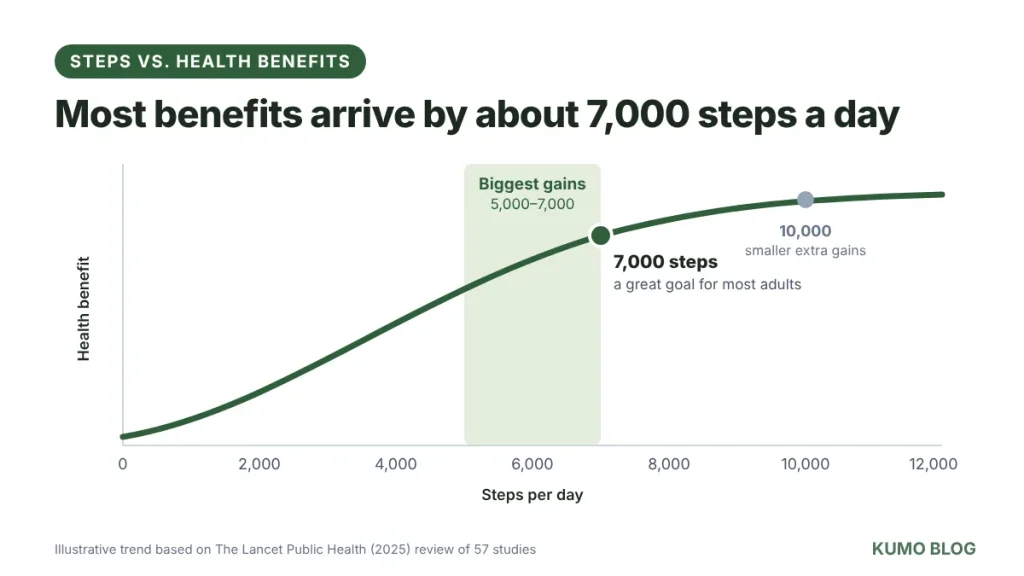
In 2025, researchers from the University of Sydney looked at 57 studies of people who wore step trackers (The Lancet Public Health). It is one of the biggest studies on steps so far.
They compared people who walked about 2,000 steps a day with people who walked about 7,000. The 7,000-step group had a much lower risk of many health problems, including heart disease, diabetes, dementia and depression. Their risk of dying early was almost half.
The biggest change happens between 5,000 and 7,000 steps. After 7,000, you still get benefits, but they grow more slowly. So more walking is good, but you don’t need to stress about reaching 10,000.
Use this simple table to see where you are:
| Steps per day | What it means |
|---|---|
| Less than 4,000 | You sit most of the day. Every extra 1,000 steps helps. |
| 4,000 to 5,000 | A good start. Health benefits begin here. |
| 5,000 to 7,000 | Your health improves the fastest in this range. |
| 7,000 to 8,000 | A great daily goal for most adults. |
| 10,000 or more | Excellent, but not a must for everyone. |
One small note: steps don’t count cycling or swimming. If you do those, they are just as good for you.
Can Walking Help You Lose Weight?
Yes, but walking alone is usually not enough. To lose fat, your body needs to use a little more energy than you eat. This is called a calorie deficit.
Walking helps you burn extra energy. But food matters more for weight loss (see our guide to healthy eating habits for people who sit all day). For example, one cup of sweet milk tea with biscuits can cancel out a 20-minute walk. So think of it this way: food controls your weight, and walking keeps you healthy. You need both.
Can Walking Reduce Belly Fat?
Not directly. Many people believe you can burn fat from one area, like the belly, by exercising that area. This is a myth. Your body loses fat from everywhere at the same time, not from one chosen spot (The Conversation).
The good news is that belly fat often goes down once you start losing fat overall. So the plan for a flatter tummy is simple: walk every day, do some strength exercises, eat a little less, and sleep well. Sit-ups make your stomach muscles stronger, but they won’t remove the fat on top.
Why Walking Speed Matters
How fast you walk is also important. A slow stroll is good, but a brisk walk is even better for your heart.
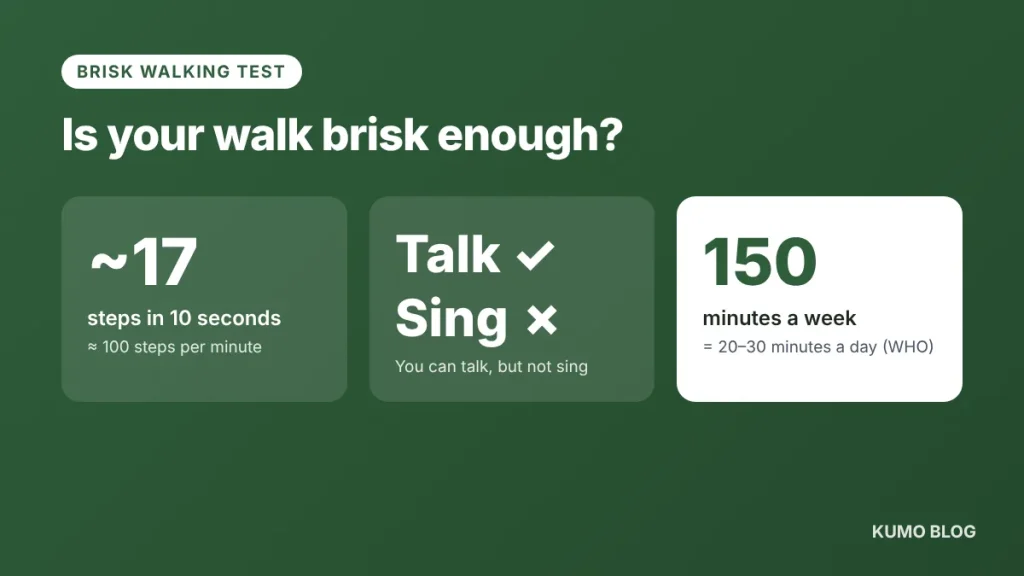
What is a brisk walk? It is a pace where you can still talk, but you can’t sing. Researchers say this is about 100 steps per minute (UMass Amherst).
An easy way to check: count your steps for 10 seconds. If you count about 17, you are walking briskly.
The World Health Organization suggests 150 minutes of this kind of activity every week (WHO). That is only 20 to 30 minutes of brisk walking a day.
5 Habits That Work Best With Walking
Walking works best when you combine it with a few other simple habits.
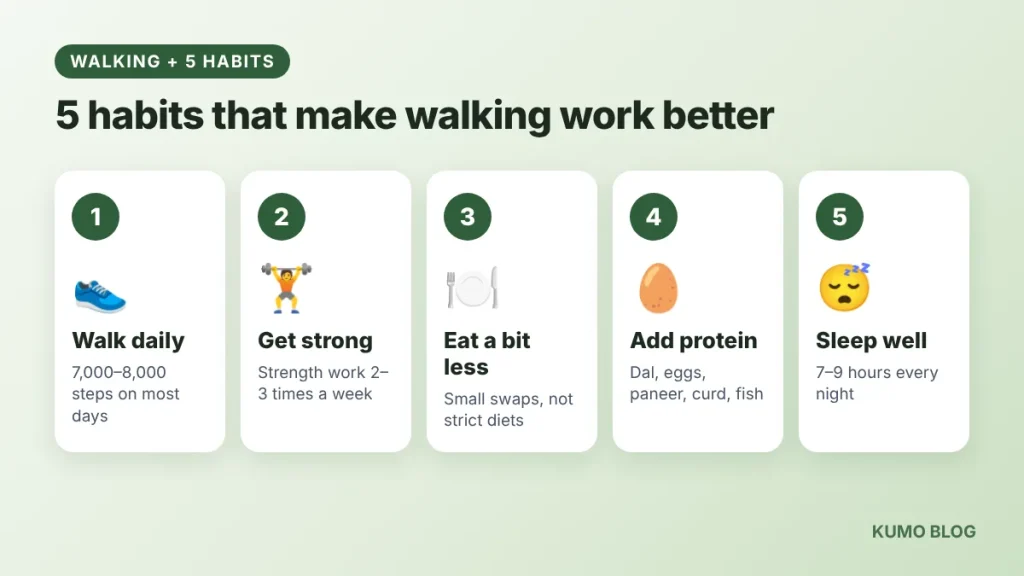
- Walk every day. Aim for 7,000 to 8,000 steps on most days.
- Do strength exercises 2 to 3 times a week. Squats, lunges and wall push-ups at home are enough. They help you keep your muscles while you lose fat.
- Eat a little less, not too little. Small changes, like less rice or fewer fried snacks, work better than strict diets.
- Add protein to every meal. Dal, eggs, chana, paneer, curd, chicken, fish and soybean keep you full for longer.
- Sleep 7 to 9 hours. Poor sleep makes you hungrier and makes you crave sweet and oily food.
Too busy for all five? Start with daily walking and one small food change. Add the rest later.
A Simple Weekly Walking Plan
If you have an office job and a family to look after, this plan is easy to follow:
| Day | Walking | Strength exercise (20 min) |
|---|---|---|
| Sunday | 7,000 steps + 15 min brisk walk | Yes |
| Monday | 7,000 to 8,000 steps | No |
| Tuesday | 7,000 steps + 15 min brisk walk | Yes |
| Wednesday | 6,000 to 7,000 steps (busy day is fine) | No |
| Thursday | 7,000 steps + 20 min brisk walk | Yes |
| Friday | 7,000 to 8,000 steps | No |
| Saturday | Longer family walk or short hike, 8,000 to 10,000 steps | Rest |
If you walk only 4,000 steps now, don’t jump to 8,000 at once. Add 500 to 1,000 steps each week. Slow and steady is easier to keep.
10 Easy Ways to Walk More Every Day
- Take a 10-minute walk after lunch and dinner.
- Walk around while talking on the phone.
- Use the stairs instead of the lift.
- Get off the bus or micro one stop early.
- Stand up and walk for 2 to 3 minutes every hour at work. It also helps you build a more productive work routine.
- Walk to your colleague’s desk instead of sending a message.
- Walk to the nearby shop for vegetables or milk.
- Go for an evening walk with your family.
- Walk around while your tea is boiling.
- On Saturdays, visit a park, a temple or a short hill trail, like our team outing to Ban Jungle Tarkeshwor.
Which Goal Is Yours?
| Your goal | Daily steps | What else to do |
|---|---|---|
| Reduce belly fat | 7,000 to 8,000 | Eat a little less, less sugar, more protein, good sleep |
| Lose fat but keep muscle | 7,000 to 8,000 | Strength exercises 3 times a week, protein in every meal |
| Better health and fitness | 7,000 or more | 20 to 30 minutes of brisk walking most days |
| All of the above | 7,000 to 8,000 | Follow all 5 habits, one at a time |
As you can see, the plan is almost the same for everyone. Walking is the base for all of them.
Frequently Asked Questions
Is 10,000 steps a day necessary?
No. Most health benefits come at around 7,000 steps a day. 10,000 is a good goal if you can reach it, but it is not a must.
Is 5,000 steps a day enough?
It is a good start and much better than sitting all day. If you can, slowly increase it to 7,000.
How many steps a day to lose weight?
Around 7,000 to 8,000 steps a day helps, but you also need to watch what you eat. Walking alone won’t cause big weight loss.
Can I lose belly fat just by walking?
Walking helps you lose fat from your whole body, including your belly. But you can’t choose to lose fat only from your belly.
How long does it take to walk 7,000 steps?
About 60 to 70 minutes in total. You don’t have to do it at once. Your normal daily movement already adds up to a few thousand steps.
Is it better to walk in the morning or evening?
The best time is the time you can follow regularly. A short walk after meals is also good for your blood sugar.
How many steps a day should I walk for my age?
A large study found that adults over 60 got most of the benefits at about 6,000 to 8,000 steps a day, while adults under 60 benefited up to about 8,000 to 10,000 steps a day (The Lancet Public Health, 2022).
How many steps are in 1 km?
Roughly 1,300 steps, depending on your height and stride. So 7,000 steps is about 5 km of walking spread across your day.
Final Thoughts: How Many Steps a Day Is Right for You?
The 10,000 steps goal started as an advertisement, not a health rule. For most people, 7,000 to 8,000 steps a day, some brisk walking and a little strength exercise are enough to stay healthy.
So if you reach 10,000 steps, great. If you only manage 6,000 on a busy day, that is fine too. What matters most is that you keep moving, day after day.
Note: This article is for general information only. If you have a health problem, are pregnant, or haven’t exercised in a long time, talk to your doctor first.


 Shreya Khadka