
Introduction
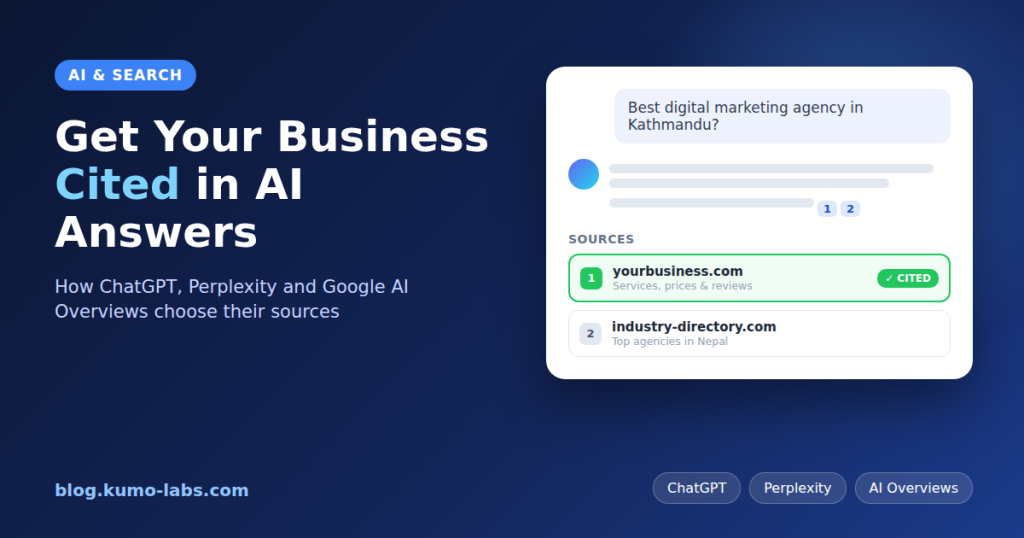
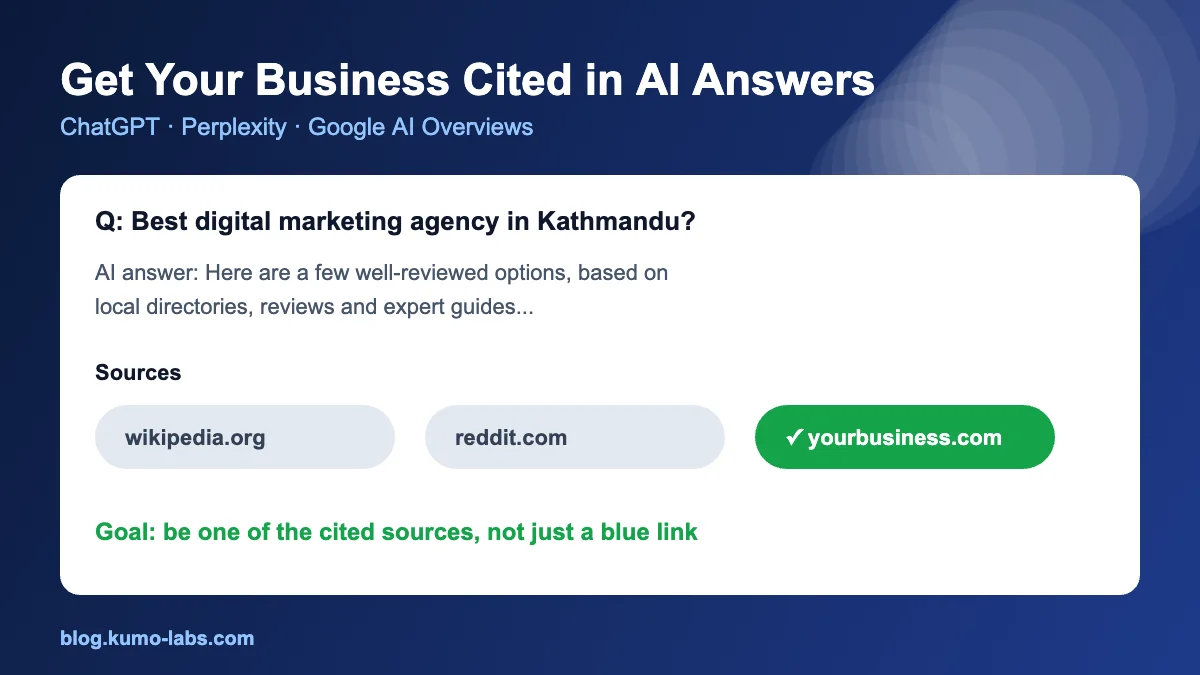
Ask ChatGPT “best digital marketing agency in Kathmandu” and you get an answer, not a list of ten blue links. That answer names a few businesses and links to a few sources. If yours isn’t one of them, the customer may never see you.
This is the shift behind Generative Engine Optimization (GEO). Ranking on Google still matters, but being cited inside the AI answer is now a second front. The good news: most of what earns AI citations is solid SEO done well, plus a few habits that make your content easy for AI to quote.
In this guide, you’ll learn how to get your business cited in ChatGPT, Perplexity and Google AI Overviews: how each engine chooses its sources, and the exact steps to get your brand mentioned in its answers.
How each AI engine picks its sources
All three engines search the live web, pick a handful of pages, and summarize them. But each leans on different sources.
| Engine | Where it finds pages | Sources it favors | What this means for you |
|---|---|---|---|
| ChatGPT search | Its own crawler (OAI-SearchBot) plus Bing’s index | Wikipedia, big publishers, well-known brands | Be indexed in Bing, allow OAI-SearchBot, build brand mentions |
| Perplexity | Real-time web search, cites every claim | Reddit, YouTube, review and industry sites | Be active in communities and publish fresh, factual pages |
| Google AI Overviews | Google’s own index, using “query fan-out” | Pages already ranking well, plus Reddit, YouTube, Quora | Strong classic SEO is the entry ticket |
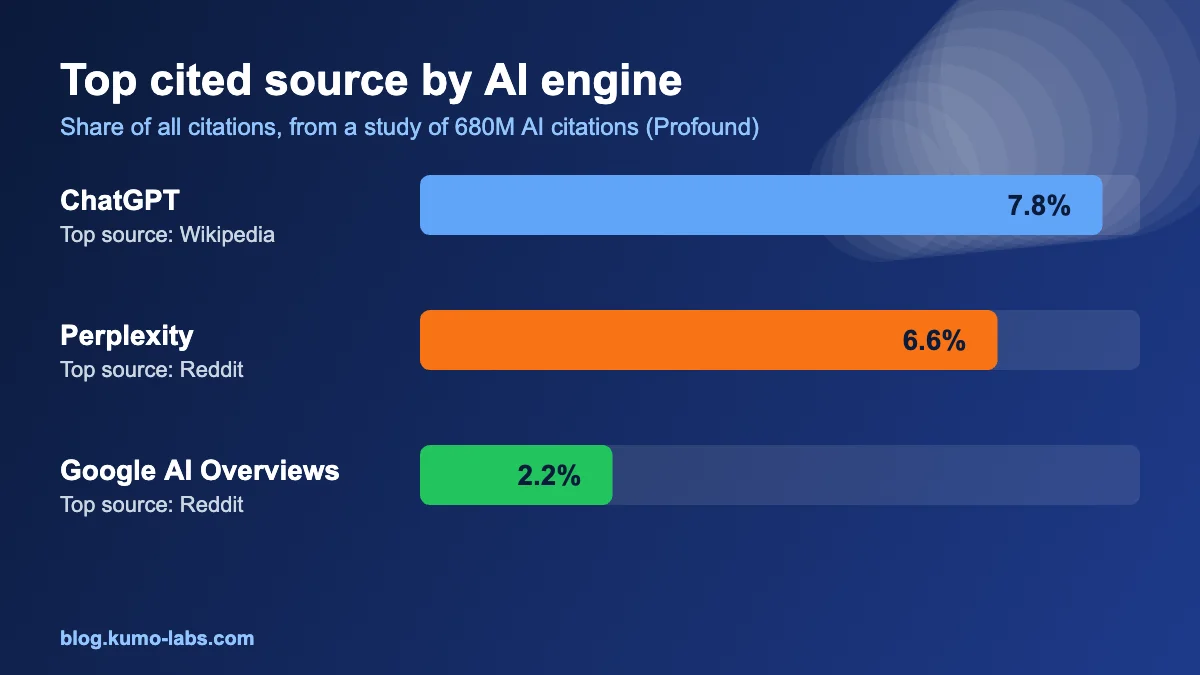
A study of 680 million AI citations by Profound found Wikipedia was ChatGPT’s top source (7.8% of citations), while Reddit led on Perplexity (6.6%) and Google AI Overviews (2.2%).
ChatGPT
Getting cited in ChatGPT starts with access. OpenAI says any public website can appear in ChatGPT search, as long as it doesn’t block OAI-SearchBot in robots.txt. Note that this is different from GPTBot, which collects training data. You can block GPTBot and still appear in search.
ChatGPT also leans heavily on Bing. One analysis cited by Conbersa found 87% of ChatGPT search citations matched Bing’s top results. If you’ve never opened Bing Webmaster Tools, start there.
Perplexity
Perplexity searches the web in real time for every question and shows numbered citations beside each claim. It rewards pages that are recent, specific and easy to quote. It also pulls heavily from discussions on Reddit and videos on YouTube.
Google AI Overviews
Google is clear: there are no extra requirements to appear in AI Overviews or AI Mode. Your page must be indexed and eligible for a snippet. No special schema or “AI text file” is needed.
What’s different is query fan-out: Google runs several related searches behind the scenes and pulls links from each. A page that answers one sub-question clearly can get cited even if it doesn’t rank #1 for the main query.
8 steps to get your business cited in ChatGPT and other AI answers
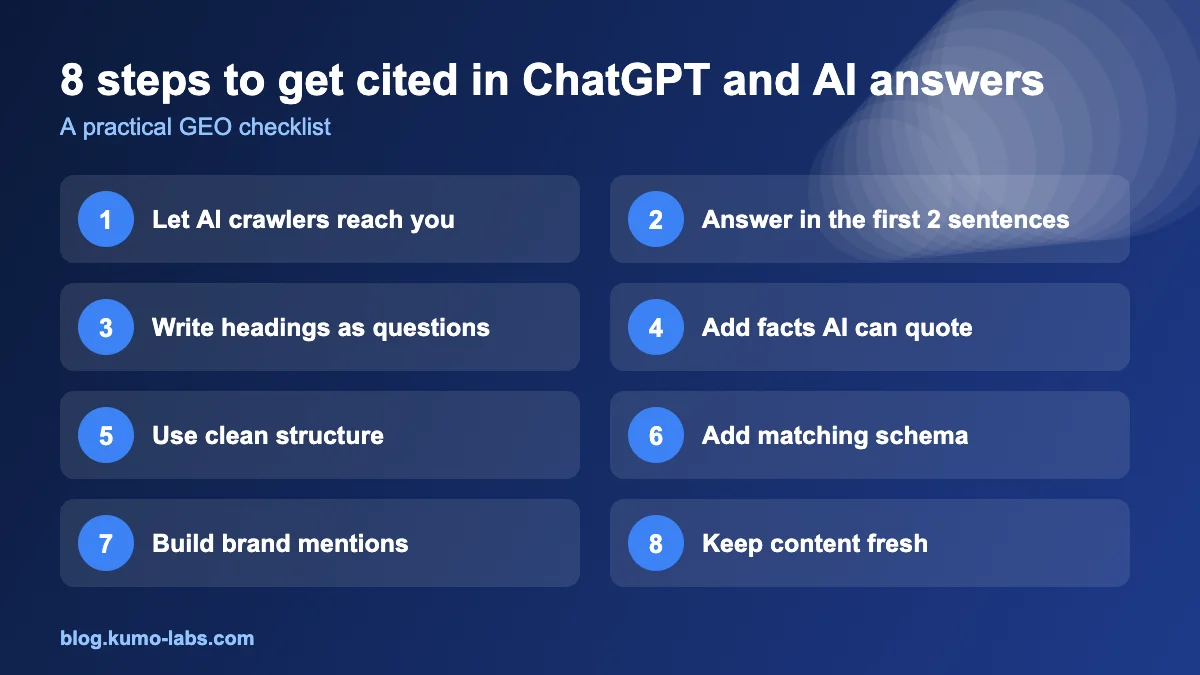
1. Make sure AI crawlers can reach you
- Check robots.txt: allow Googlebot, Bingbot, OAI-SearchBot and PerplexityBot.
- Submit your sitemap to both Google Search Console and Bing Webmaster Tools.
- Keep key content in plain HTML text, not only inside images, PDFs or heavy JavaScript.
2. Answer the question in the first two sentences
AI engines quote passages, not whole pages. Put a clear, direct answer right under each heading, then explain.
- Weak: “SEO is a very important topic that many businesses are talking about these days…”
- Strong: “SEO (Search Engine Optimization) is the process of improving a website so it ranks higher in search results for relevant searches.”
3. Write headings as real questions
Use the words customers actually type or ask: “How much does a website cost in Nepal?” or “What is the difference between SEO and GEO?” This matches the sub-questions AI engines search for during query fan-out.
4. Add facts AI can quote
AI answers love specifics: numbers, prices, dates, steps, comparisons and definitions. Add original data where you can, such as results from your own client projects or a small survey. Unique facts are hard to find elsewhere, so they get cited.
5. Use clean structure
- Short paragraphs (2–3 sentences)
- Bullet lists for steps and features
- Tables for comparisons and pricing
- An FAQ section at the end of key pages
6. Add structured data that matches your page
Schema isn’t required, but it helps search engines understand who you are. Use Organization or LocalBusiness, Article, and FAQPage schema where it fits. Keep it matched to what’s visible on the page.
7. Build brand mentions beyond your own site
AI engines trust what many sources say about you. Aim to be mentioned on:
- Reddit threads and Quora answers in your niche (helpful answers, not spam)
- YouTube videos explaining your service
- Industry directories, review sites and local news
- Guest posts and interviews on respected sites
- Wikipedia or Wikidata, only if your business truly meets notability rules
8. Keep content fresh and show expertise
- Add a visible “last updated” date and update key pages every few months.
- Show a real author with a short bio and credentials.
- Link to trusted sources and show real examples, screenshots and case studies.
Tips for businesses in Nepal
Few Nepali businesses are working on AI visibility yet, so the field is open. A few local moves go a long way: (New to online marketing? Start with our beginner’s guide to digital marketing.)
- Complete your Google Business Profile. Add accurate hours, services, photos and replies to reviews. Google’s own guidance says to keep this data current for AI features.
- Claim your Bing Places listing. It’s free, rarely done in Nepal, and feeds Bing, which ChatGPT relies on.
- Keep your name, address and phone number identical everywhere: your site, Facebook, directories and Google.
- Target local questions. Write pages like “Website design cost in Nepal (2026)” or “Best tools for SEO in Kathmandu.” Global sites rarely answer these well.
- Quote prices in NPR and mention local cities, since AI answers for local queries look for local specifics.
- Get featured in Nepali media and directories, such as local business listings, tech news sites and startup communities.
How to track your AI citations
You can’t improve what you don’t measure. Use this simple monthly routine to check whether you’re being cited in ChatGPT, Perplexity and Google AI Overviews:
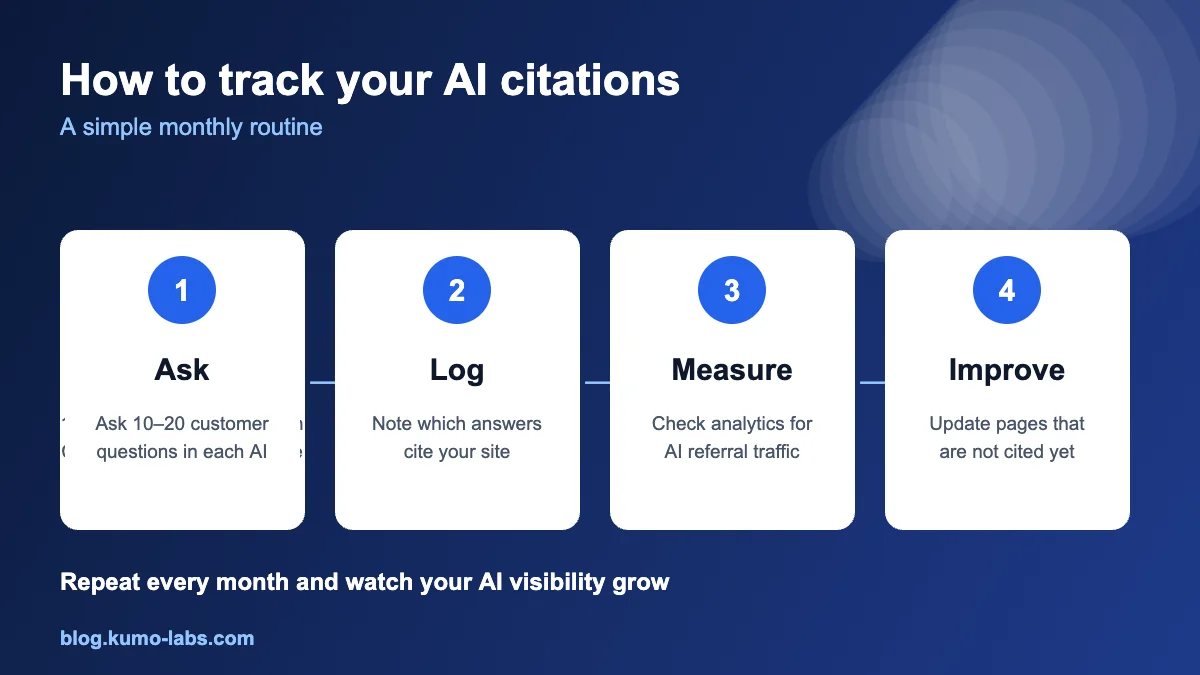
- Ask the engines yourself. Make a list of 10–20 questions your customers ask. Once a month, ask them in ChatGPT, Perplexity and Google, and note whether you’re cited.
- Check your analytics. ChatGPT adds utm_source=chatgpt.com to links it sends. In Google Analytics 4, look for referrals from chatgpt.com, perplexity.ai and gemini.google.com.
- Use Google Search Console. AI Overviews and AI Mode traffic is counted within your normal Search performance report.
- Try a GEO tracking tool if you need scale. Several tools now track brand mentions across AI engines automatically.
Common mistakes to avoid
- Blocking AI crawlers by accident. Some security plugins and CDN settings block OAI-SearchBot or PerplexityBot. Check them.
- Ignoring Bing. If you’re not in Bing, you’re much less likely to show up in ChatGPT.
- Mass-producing thin AI content. Generic articles add nothing new, so AI engines have no reason to cite them.
- Spamming Reddit or Quora. Communities remove promotional posts fast. Be helpful first.
- Hiding answers behind long intros. If the answer is in paragraph six, AI will quote someone else.
FAQ
What is GEO? Generative Engine Optimization (GEO) is the practice of making your content easy for AI engines like ChatGPT, Perplexity and Google AI Overviews to find, trust and cite. Read more in our GEO strategy guide.
Is GEO different from SEO? GEO builds on SEO. Good SEO gets you indexed and ranked; GEO adds clear answers, quotable facts and brand mentions that AI engines prefer.
Do I need an llms.txt file or special schema? Not for Google. Google says no special files or markup are needed for AI Overviews. Standard structured data can still help.
How long does it take to get cited in ChatGPT or Perplexity? Perplexity and ChatGPT search the live web, so a well-structured new page can be cited within weeks once indexed. Building brand authority takes months.
Can small businesses compete with big brands? Yes, especially on local and niche questions. A detailed page about your service in your city often beats a generic global article.
Conclusion
AI answers are becoming the first thing customers see. To get cited in ChatGPT, Perplexity and Google AI Overviews, make sure AI crawlers can reach you, answer questions clearly, add facts worth quoting, and build mentions of your brand across the web.
Start small: check your robots.txt, set up Bing Webmaster Tools, and rewrite your top five pages with direct answers and FAQs.
Want help getting your business seen in AI search? Kumo Labs helps businesses with SEO, GEO and web development. Contact us to get started.

 Shreya Khadka
 Manish Basnyat