
 admin
admin What Is Claude AI, Really?
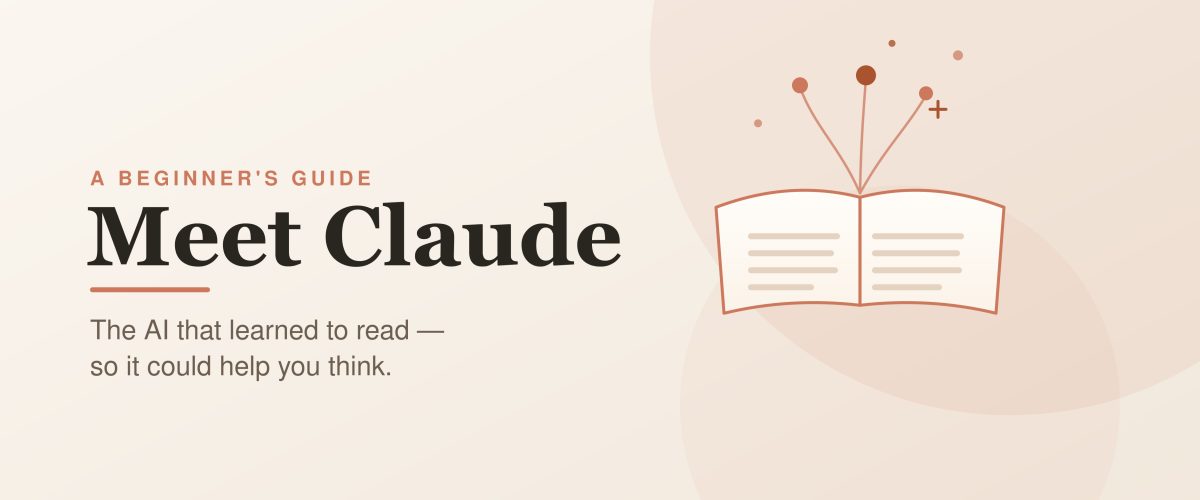
Claude AI is an assistant made by a company called Anthropic. You type something — a question, a request, a document to summarize — and Claude writes back a helpful response. The first version of Claude AI came out in March 2023, and there are now several versions, each better suited to different kinds of work.
If you’ve used a chatbot before, that’s the basic experience. But underneath the simple chat window, Claude AI can do a lot more than have a conversation: it can read entire books or long documents at once, look at images you upload, help write and fix computer code, and even carry out multi-step tasks on your behalf. Everything starts, though, from that one simple idea — you ask, it responds.
A helpful way to think about what Claude is: it’s a very sophisticated prediction machine. It has read an enormous amount of text, and from all that reading it has become remarkably good at figuring out what words should come next in a way that’s useful to you. That sounds almost too simple to explain something that can write an essay or debug code — but as we’ll see, “predict the next word extremely well” turns out to be surprisingly powerful.
How Does Claude AI Actually Work?
Let’s open the hood, gently.
Claude AI is a type of large language model — “large” because it was trained on a huge amount of text, and “language model” because its job is to work with language. You’ll see it abbreviated as LLM.
The way an LLM learns is a bit like how you’d get good at finishing other people’s sentences if you read millions of books. Show it enough text and it starts to notice patterns: which words tend to follow which, how ideas connect, how a helpful answer is usually structured. It’s not memorizing and looking things up like a search engine. It’s more like it has absorbed the patterns of language and knowledge, and it uses those patterns to generate something new each time.
There’s one clever trick worth naming. When Claude reads your message, it doesn’t just plod through word by word and forget the beginning by the time it reaches the end. It can pay attention to every part of what you wrote at once, weighing which parts matter most for its answer. This ability — called attention — is a big reason modern AI can stay on-topic across a long, complicated conversation instead of losing the thread.
The training happens in two stages. First, Claude reads a vast library of text to learn language and facts about the world. Then, in a second stage, it’s carefully shaped into a polite, helpful, honest assistant rather than just a text-completing machine. That second stage is where Anthropic does something a little different from most companies.
What Makes Claude AI Different: Training It with Principles
Most AI assistants are polished up by having people rate their answers — humans look at responses and say “this one’s good, this one’s not,” and the AI learns to produce more of the good ones.
Anthropic uses a method it calls Constitutional AI. The idea is to give the AI a written set of principles — think of it as a short rulebook or “constitution” — describing how it should behave: be helpful, be honest, avoid causing harm, respect the person it’s talking to. During training, Claude learns to check its own answers against those principles and improve them.
Why does this matter to you as a user? It’s a big part of why Claude tends to explain its thinking, disagree with you thoughtfully instead of just saying “no,” and stay calm and balanced on touchy subjects. Good behavior isn’t a filter slapped on at the end — it’s part of how Claude is built from the ground up.
The Claude family: different models for different jobs
Here’s something that confuses newcomers: there isn’t one Claude AI. There’s a family of them, and they’re named in tiers based on how powerful they are. The names stay consistent across versions, which makes them easy to remember:
Haiku is the fast, inexpensive one. Think of it as the reliable everyday helper — great when you need quick answers or need to handle a huge number of small tasks cheaply.
Sonnet is the balanced, all-rounder one. It’s smart and reasonably fast without costing a lot, which makes it the sensible default for most work.
Opus is the heavy hitter — the one you bring in for genuinely hard problems that need deep thinking, like complex programming or careful analysis. It’s more capable, but slower and pricier.
Above these sits Anthropic’s newest and most powerful tier, whose main model is called Claude Fable 5 — reserved for the very hardest tasks.
Here’s the useful mental shortcut: Haiku for speed, Sonnet for balance, Opus for power, Fable for the frontier. The exact version numbers change often, because Anthropic releases new and improved models frequently — so remember the tiers, and look up the current Claude AI version when you need one.
Related Questions
What company makes Claude AI?
Claude AI is made by Anthropic, an AI safety company that develops Claude as a general-purpose AI assistant for tasks like writing, research, coding, and summarizing documents.
When was Claude AI first released?
The first version of Claude AI was released in March 2023, and Anthropic has since released several newer versions with improved capabilities.
What can Claude AI actually do?
Claude AI can hold conversations, read and summarize long documents, help write and fix code, analyze images, and assist with a wide range of writing and research tasks.
Is Claude AI free to use?
Claude AI offers a free tier with usage limits, along with paid plans that provide higher usage limits and access to more capable models.
How is Claude AI different from other AI chatbots?
Claude AI is built with a strong focus on safety and helpfulness, and it is known for handling long documents, nuanced instructions, and complex reasoning tasks particularly well.
 Ilina Maharjan