

Project management for ecommerce sites breaks in predictable ways. Teams don’t fail because they lack skill — they fail because ecommerce has constraints most project management advice doesn’t account for: hard seasonal deadlines, payment and inventory systems you don’t control, and a site that has to work perfectly the one day of the year traffic triples. Here’s how to manage an ecommerce build without getting blindsided by the things that actually cause launch-day fires.
1. Project Management for Ecommerce: Your Deadline Isn’t Negotiable
Most software projects can slip a launch date without real consequence. Ecommerce projects often can’t. If you’re launching before Black Friday, a back-to-school season, or a product drop, the date is fixed and the scope has to flex — not the other way around.
Practical approach:
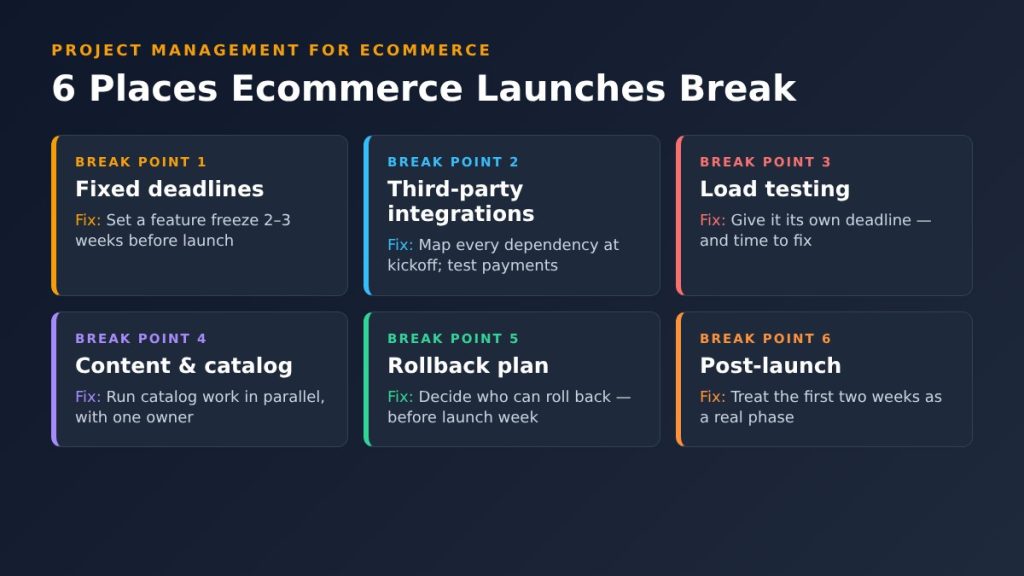
- Set a feature freeze date at least 2–3 weeks before launch, separate from the launch date itself
- Build a “must-have vs. nice-to-have” list early, and get stakeholder sign-off on it before development starts — not during crunch week
- Treat the freeze date as sacred. Anything proposed after it goes into a post-launch backlog, no exceptions
2. Third-party integrations are your biggest risk, not your code
Payment gateways, inventory/ERP systems, shipping carriers, tax calculation services, email/SMS marketing tools — most ecommerce sites depend on 5–10 external services, and most launch delays trace back to one of them, not to custom code.
- Identify every third-party dependency at project kickoff, not mid-build
- Test payment flows (including edge cases like declined cards, partial refunds, currency conversion) weeks before launch, not days
- Have a fallback plan if a critical integration partner has an outage on launch day — know who to call and how fast they typically respond
3. Project Management for Ecommerce: Load Testing Isn’t Optional
A site that works fine in QA can fall over completely on launch day or during a sale. This is one of the most common and most preventable ecommerce failures.
- Schedule load testing as its own timeline item with its own deadline, not something squeezed in at the end
- Test realistic worst-case scenarios: flash sale traffic spikes, checkout under load, cart/inventory race conditions
- Budget time to actually fix what load testing finds — testing without room to remediate just tells you how you’ll fail
4. Content and catalog work is a project of its own
Product photography, descriptions, categorization, pricing, and variants often take longer than the engineering. Teams that treat catalog population as an afterthought consistently end up delaying launch for content reasons, not code reasons. Well-written, consistent product content also helps your store get found in search; if you are new to that side of things, start with our guide on what SEO is.
- Start catalog/content work in parallel with development, not after
- Assign a single owner for catalog data quality — inconsistent categorization and missing product data cause real revenue loss post-launch
- Build a content freeze date alongside your feature freeze date
5. Define your rollback plan before you need it
Ecommerce sites can’t afford extended downtime, especially during peak periods. Know in advance:
- How to roll back a bad deploy quickly
- Who has authority to make that call, and how fast
- Whether checkout/payment state stays consistent if you do roll back mid-transaction
Write this down before launch week, not while you’re debugging a broken checkout at 2am.
6. Post-launch is a phase, not an afterthought
The two weeks after launch matter as much as the two weeks before. Budget dedicated engineering time for:
- Monitoring conversion funnel drop-off (a broken checkout step won’t show up as an “error” — it shows up as abandoned carts)
- Fast-turnaround bug fixes for issues real customers find that QA didn’t catch
- A retro specifically on what nearly went wrong, while it’s still fresh
None of this requires a bigger team or a longer timeline. Solid project management for ecommerce sites mostly means front-loading the risks — third-party dependencies, load testing, catalog work, and rollback plans — instead of discovering them during launch week. If you’re also navigating the people side of this, see our guide on managing the team while managing the project.
Related Questions
Why do ecommerce website launches fail most often?
Ecommerce launches most often fail because of fixed, non-negotiable deadlines like seasonal sales, dependencies on third-party payment and inventory systems, and underestimating how much traffic spikes can strain a site on launch day.
What is the biggest project management mistake in ecommerce projects?
The biggest mistake is treating an ecommerce launch like a typical software project with flexible timelines, when in reality deadlines tied to holidays or sales events cannot move, which changes how risk should be managed.
How far in advance should ecommerce launch planning start?
Most experienced teams start planning at least two to three months before a major launch or seasonal deadline, leaving enough time for integration testing, load testing, and fixing issues discovered late.
What should be tested before an ecommerce site goes live?
Before launch, teams should test payment processing, inventory syncing, checkout flow under load, mobile responsiveness, and third-party integrations, since these are the areas most likely to fail under real traffic.
How can a team prepare for traffic spikes on launch day?
Teams can prepare by load testing the site under expected peak traffic, using scalable hosting or a CDN, and having a rollback plan ready in case something breaks during the highest-traffic hours.

 Roshan